H.C.F. of Polynomials by Long Division Method | G.C.F of Two Polynomials by Long Division

Here we are giving the details on how to calculate the greatest common factor of two polynomials using the long division method. Students must have a look at the complete procedure to find the H.C.F of Polynomials by Long Division Method and few solved examples on it. We are using this long division method especially when there is no scope to find the highest common factor of polynomials by factorization.

How to find H.C.F of Polynomials by Long Division?

The step by step procedure to evaluate the G.C.F of two polynomials by long division method manually is provided. For the sake of your comfort and convenience, the steps are listed below make use of them.

  • Arrange the given two polynomials in the descending order of powers of any of its variables.
  • If there is any common factor in the polynomials, then separate it. Multiply the common factors to get the H.C.F of them.
  • Just like the determination of G.C.F by the method of division in arithmetic, here also division is not complete. In every step, the division of that step is divided by the obtained remainder. At any step, if any common factor is available in the remainder then it should be taken out, then perform division.
  • In every step, the term in the quotient should be found by comparing the first term of the dividend with the first term of the divisor. Sometimes, if necessary, the dividend may be multiplied by a multiplier of a factor.

Highest Common Factor of Polynomials by Long Division Method

Example 1.

Find the H.C.F of 6x³ – 17x² – 5x + 6, 6x³ – 5x² – 3x + 2 and 3x³ – 7x² + 4 by using the long division method.

Solution:

Given three polynomials are 6x³ – 17x² – 5x + 6, 6x³ – 5x² – 3x + 2 and 3x³ – 7x² + 4

All the polynomials are arranged in the descending order of the powers of the variable ‘x’. And the polynomials have no common factors between them. So, by the long division method

The H.C.F. of 6x³ – 17x² – 5x + 6, 6x³ – 5x² – 3x + 2 is 6x² + x – 2.

Now, it is to be seen whether the third expression 3x³ – 7x² + 4 is divisible by 6x² + x – 2 or not. If it is not, then the H.C.F. of them is to be determined by the division method.


Therefore, the H.C.F. of 6x³ – 17x² – 5x + 6, 6x³ – 5x² – 3x + 2 and 3x³ – 7x² + 4 is 3x + 2.

Example 2.

Calculate the Highest Common Factor of polynomials 7a³ – 28a² + 49a – 42, 5a³ – 25a² + 50a – 40 by using the long division method?

Solution:

Given two polynomials are 7a³ – 28a² + 49a – 42, 5a³ – 25a² + 50a – 40

Consider f(a) = 7a³ – 28a² + 49a – 42, g(a) = 5a³ – 25a² + 50a – 40

Take out the common factors,

f(a) = 7(a³ – 4a² + 7a – 6)

g(a) = 5(a³ – 5a² + 10a – 8)

At the time of writing the final result the H.C.F. of 7 and 5 i.e. 35 is to be multiplied with the divisor of the last step.

Therefore, the H.C.F of 7a³ – 28a² + 49a – 42, 5a³ – 25a² + 50a – 40 is 35 * 2(a – 2) = 70(a – 2).

Example 3.

Find the G.C.F of x⁶ + 2x⁵ + 5x³ + 4x² + 6 and x³ + 2 by using the long division method?

Solution:

Given two polynomials are x⁶ + 2x⁵ + 5x³ + 4x² + 6 and x³ + 2.

By arranging the two polynomials in the descending order of powers of x we get,

x⁶ + 2x⁵ + 0x⁴ + 5x³ + 4x² + 0x + 6 and x³ + 0x² + 0x + 2

There are no common factors in those polynomials. So, dive them by using the long division method

Therefore, the H.C.F. of x⁶ + 2x⁵ + 5x³ + 4x² + 6 and x³ + 2 is x³ + 2x² + 3.

H.C.F. of Polynomials by Division Method | How to find HCF of Polynomials?

Do you want to calculate the highest common factor of polynomials by using the division method? If yes then stay on this page. Here we are providing the detailed step by step procedure to find the G.C.F of polynomials by division method. Along with the steps you can also check some solved example questions from the below sections.

How to find the Highest Common Factor of Polynomials by Division Method?

We are using the division method to find the G.C.F of polynomials when the polynomials have the highest factor and it is difficult to compute the HCF. Then follow the steps and instructions provided below and get the answer easily.

  • Let us take two polynomials f(x), g(x).
  • Divide the polynomials f(x) / g(x) to get f(x) = g(x) * q(x) + r(x). Here the degree of g(x) > degree of r(x).
  • If the remainder r(x) is zer0, then g(x) is the highest common factor of polynomials.
  • If the remainder is not equal to zero, then again divide g(x) by r(x) to obtain g(x) = r(x) * q(x) + r1(x). Here if r1(x) is zero then required H.C.F is r(x).
  • If it is not zero, then continue the process until we get zero as a remainder.

Solved Examples on GCF of Polynomials

Example 1.

Find the H.C.F of x⁴ + 4x³ + x – 10 and x² + 3x – 5 by using the division method?

Solution:

Given polynomials are f(x) = x⁴ + 4x³ + x – 10, g(x) = x² + 3x – 5

Arranging the polynomials in the descending order f(x) = 1x⁴ + 4x³ + 0x² + x – 10

By using the division method,

The remainder is zero.

So, the required H.C.F of x⁴ + 4x³ + x – 10 and x² + 3x – 5 is x² + 3x – 5.

Example 2.

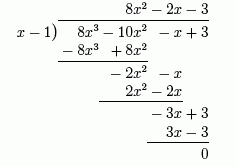
Calculate the greatest common factor of 8x³ – 10x² – x + 3 and x – 1 by using the division method?

Solution:

Given two polynomials are 8x³ – 10x² – x + 3 and x – 1

Let us take f(x) = 8x³ – 10x² – x + 3, g(x) = x – 1

Divide f(x) by g(x)

The remainder is zero.

So, the required H.C.F of 8x³ – 10x² – x + 3 and x – 1 is x – 1.

Example 3.

Find the HCF of the following pairs of polynomials using the division algorithm

2 x³ + 2 x² + 2 x + 2 , 6 x³ + 12 x² + 6 x + 12?

Solution:

Given two polynomials are 2 x³ + 2 x² + 2 x + 2 , 6 x³ + 12 x² + 6 x + 12

Let f(x) = 2 x³ + 2 x² + 2 x + 2 , g(x) = 6 x³ + 12 x² + 6 x + 12

Take 2 common from the first polynomial.

f(x) = 2(x³ + x² + x + 1)

Take 6 common from the second polynomial.

g(x) = 6(x³ + 2x² + x + 2)

Divide f(x) by g(x)


The remainder is not zero. So, we have to repeat this long division once again.

Then divide g(x) by r1(x). i.e x³ + 2x² + x + 2 by x² + 1

The remainder is zero.

The H.C.F of 2, 6 is 2.

So, required H.C.F of 2 x³ + 2 x² + 2 x + 2 , 6 x³ + 12 x² + 6 x + 12 is 2 ( x² + 1).

Practice Test on Direct Variation and Inverse Variation

Hello Aspirants!! Are you one of those candidates who are preparing for competitive exams? If yes, Don’t worry. We are here to help in all the possible ways we can. Know the important questions of direct variation and inverse variation problems. Go through the below sections to know the study material and step by step procedure to solve problems.

Direct Variation and Inverse Variation Examples

Question 1.

y varies directly with x. If x=3 when y=12, what is y when x=9?

A. 42

B. 36

C. 40

D. 38

Solution: B(36)

Explanation:

From the variation equation of y=kx

12=k(3)

Dividing both sides by 3

12/3=k(3)/3

4=k

Substituting the value of k=4 in the equation y=kx

y=4(9)

y=36

Question 2.

y varies inversely with x. If x = 4 when y = 48, what is the value of y when x is 8?

A. 24

B. 36

C. 48

D. 26

Solution: A (24)

Explanation:

From the variation equation of y=k/x

48/1 = k/4

k=192

Substitute the value in the equation y=k/x

y=192/8

y= 48.4/8 = 8*6*4/8 = 24

  1. x=4
  2. y=48

Multiplying the 1st equation by 2

and dividing the 2nd equation by 2

Therefore, x=8, y=24.

Question 3.

y varies jointly with x and z. If y=36 and when x=2 and z=3. Find the value of y when x=4 & z=6?

A. 50

B. 80

C. 134

D. 144

Solution: D(144)

Explanation:

From the given question, if x increases then y increases, and if z increases then y increases.

As given, x= 2 and z=3

Multiplying both the equations by 2

x=4 and z=6

As x and z are directly proportional to y. x and z doubles, therefore y also doubles.

Therefore, the value of y = 36

Multiplying by 4, the value is 144

y=144

Direct and Indirect Variation Study Material

Question 4.

y varies jointly with x and z. If y=36 when x=2 and z=3. Find the value of y when x=4 and z=6?

A. 14

B. 156

C. 122

D. 142

Solution: A(144)

Explanation:

From the variation equation y=kxz

36=k(2)(3)

36=6K

K=6

Substitute k value in the equation y=kxz

y=(4)(6)

y=24(6)

y=120

y=120+24

y=144

Question 5.

y varies inversely with the cube of x. If y is 108 when x is 2, find the value of y when x is 6?

A. 2

B. 3

C. 4

D. 6

Solution:

Explanation: C(4)

From the variation of the equation y=k/x2

As given in the question

  1. x=2
  2. y=108

Multiply the 1st equation by 3

Divide the equation by 27

Therefore, x=6, y=4

108=k/(2)<sup3

k=108(8)

k=864

y=8(108)/(6)3

y=23(27.4)/63

y=23.33.4/63

y=63.4/63

Therefore, y=4

Question 6.

The price for 75 basketballs is 1143.75 rupees. Find the price of 26 basketballs?

  1. 50 rupees
  2. 20 rupees
  3. 60 rupees
  4. 40 rupees

Solution: A (396.50 rupees)

Explanation:

Let “m” be the price of 26 basketballs

As given In the question,

The price for 75 basket ball’s is 1143.775 rupees

The price for 26 basketballs is “m”

Since, the question belongs to direct variations (For less number of basketballs, the price will be less)

We can apply cross multiplication shortcut

75*m=26*1143.75

m=(26*1143.75)/75

m=396.50

Therefore, the cost of 26 balls is 396.50 rupees.

Question 7.

A book consists of 120 papers and each paper has 35 lines. How many papers will the book consists of if each paper has 24 lines per paper?

  1. 150 papers
  2. 175 papers
  3. 200 papers
  4. 120 papers

Solution: B (175 papers)

Explanation:

Let “m” be the no of required papers

As given in the question,

There are 35 lines and 120 papers in a book

There are 24 lines and m papers in a book

Since, it is an inverse variation (for fewer lines, there are more pages)

We have to apply “straight multiplication” as it is inverse variation.

120*35=m*24

(120.35)/24 = m

175 = m

Therefore, if every paper has 24 lines, the book will contain 175 pages.

Question 8.

A truck covers some distance in 3 Hours with a speed of 60 miles per hour. Consider that the speed is increased by 30 miles per hour, find the time taken to cover the same distance by the truck?

  1. 4 Hours
  2. 5 Hours
  3. 6 Hours
  4. 2 Hours

Solution: D (2 Hours)

Explanation:

If the given speed 60 mph is increased by 30 mph, then the new speed is 90 mph

Let “m” be the required time.

In 3 hours of time, the truck covers 60 mph

For m hours of time, the truck covers 90 mph

Since it is an inverse variation (for more speed it takes less time), therefore we have to apply the “straight multiplication” shortcut.

3*60 = m*90

(3*60)/90 = m

2=m

Therefore, if the speed is increased by 30mph, then the time taken by truck is 2 Hours.

Question 9.

In 36.5 weeks, Nandu raised 2,372.50 rupees for cancer research. If he works for 20 weeks, how much money he will raise?

  1. 1300 rupees
  2. 1400 rupees
  3. 1600 rupees
  4. 1100 rupees

Solution: A (1300 rupees)

Explanation:

Let “m” be the required amount of money

From the given question, for 36.5 weeks, Nandu raised 2,372.50 rupees. Suppose, for 20 weeks, Nandu raised m rupees.

Since, it is a direct variation(for less number of weeks, the amount raised will be less), we have to apply the “cross multiplication” shortcut.

36.5*m = 20*2372.50

m = (20*2372.50)/36.5

m=1300

Therefore, the money raised in 20 weeks is 1300 rupees

Question 10.

John takes 15 days to lose 30 kgs of his weight by doing 30 minutes of exercise per day. How many days will he need if continues the exercise for 1 Hour 30 minutes per day?

  1. 10 Days
  2. 5 Days
  3. 2 Days
  4. 8 Days

Solution: B (5 Days)

Explanation:

Let “m” be the required no of days.

For 15 Days, John takes 30 minutes, suppose that in John takes 90 minutes in m days

As, from the given question, it is an inverse variation (for more minutes per day, fewer days are required to reduce weight), therefore we have to apply “straight multiplication” shortcut.

15*30=m*90

(15*30)/90=m

5=m

Therefore, if John does exercise for 1 Hour 30 minutes per day, he takes 5 days to reduce 30 kilograms of weight.

Hope the Practice Test on Direct Variation and Inverse Variation, will help you to know the various models and questions asked. With the help of the given questions, you can easily score better marks. If you need any further clarifications, then you can comment us below. Moreover, stay tuned to our site to know more shortcuts.

Cube and Cube Roots | Perfect Cube, How to Find the Cube Root, Properties

Cube and Cube Root of numbers can be found easily using the simplest and quickest methods. Check the complete details of the How to Find the Cube and Cube Root of a Number? We have covered everything like the definition of cube and Cubes Relation with Cube Numbers, Perfect Cube, etc. For better understanding, we even jotted the solved examples explained in detail.

Cube

The cube of a number is calculated by multiplying a number itself by 3 times. If you consider a number n, then the cube of a number n is n. Here, n is the natural number.

Example:

1, 8, 27 are the cube number of the numbers 1, 2, and 3 respectively.

Cube of 9 = 9 × 9 × 9 = 729
Cube of 8 = 8 × 8 × 8 = 512
Cube of 6 = 6 × 6 × 6 = 216

Cubes Relation with Cube Numbers

In mathematics, a cube is defined as a solid figure where all edges are of the same sizes and each edge is perpendicular to other edges.

Example:

If you take cubes of 4 units, then you can form a bigger cube of 64 units. Or else, if you take cubes of 3 units, then you can form a bigger cube of 27 units.

Perfect Cube Cube Numbers

The product of the three same numbers will give you a cube of a number (perfect cube).

Example:

The cube of a number 2 is 2 × 2 × 2 = 8.
8 is a perfect cube.

Properties of Cube Numbers

1. The cube of an even number is always an even number.

Example:
(i) Find the cube of a number 2?
2 × 2 × 2 = 8
8 is an even number.
(ii) Find the cube of a number 4?
4 × 4 × 4 = 64
64 is an even number.
(iii) Find the cube of a number 6?
6 × 6 × 6 = 216

2. The cube of an odd number is always an odd number.

Example:
(i) Find the cube of a number 3?
3 × 3 × 3 = 27
27 is an odd number.
(ii) Find the cube of a number 5?
5 × 5 × 5 = 125
125 is an odd number.
(ii) Find the cube of a number 7?
7 × 7 × 7 = 343
343 is an odd number.

Units Digits in Cube Numbers

If a number is even or odd, its cube is even or odd respective to the given number. The cube of a unit’s digit always shows the below results.

(i) Cube of 1 = 1 × 1 × 1 = 1;
The Units Digits of Cube of 1 is 1.
(ii) Cube of 2 = 2 × 2 × 2 = 8
The Units Digits of Cube of 2 is 8.
(iii) Cube of 3 = 3 × 3 × 3 = 27
The Units Digits of Cube of 3 is 7.
(iv) Cube of 4 = 4 × 4 × 4 = 64
The Units Digits of Cube of 4 is 4.
(v) Cube of 5 = 5 × 5 × 5 = 125
The Units Digits of Cube of 5 is 5.
(vi) Cube of 6 = 6 × 6 × 6 = 216
The Units Digits of Cube of 6 is 6.
(vii) Cube of 7 = 7 × 7 × 7 = 343
The Units Digits of Cube of 7 is 3.
(viii) Cube of 8 = 8 × 8 × 8 = 512
The Units Digits of Cube of 8 is 2.
(ix) Cube of 9 = 9 × 9 × 9 = 729
The Units Digits of Cube of 9 is 9.

Cube roots

Cube Root of a Number is the inverse of finding the cube of a number. If the cube of a number 3 is 27, then the cube root of 27 is 3.

How to Find the Cube Root of a Number by Prime Factorisation Method?

The Prime Factorisation of any Number Cube Root can be calculated by grouping the triplets of the same numbers. Multiply the numbers by taking each one from each triplet to provide you the Cube Root of a Number.

Example:
Cube Root of 216 = 2 × 2 × 2 × 3 × 3 × 3 = 2 × 3 = 6
6 is the cube root of 216.

FAQs on Cube and Cube Roots

1. Find the cube of 3.4?
The cube of a number can be calculated by multiplying it three times.
Cube of 3.4 = 3.4 x 3.4 x 3.4 = 39.304

2. Is 288 a perfect cube? If not, find the smallest natural number by which 288 should be multiplied so that the product is a perfect cube.
The prime factorization of 288 is
288 = 2 x 2 x 2 x 6 x 6
Since we can see number 6 cannot be paired in a group of three. Therefore, 288 is not a perfect cube.
To make it a perfect cube, we have to multiply the 6 by the original number.
Thus, 2 x 2 x 2 x 6 x 6 x 6 = 1728, which is a perfect cube.
Hence, the smallest natural number which should be multiplied to 288 to make a perfect cube is 6.

3: Find the smallest number by which 256 must be divided to obtain a perfect cube.
The prime factorization of 256 is
256 = 2×2×2×2×2×2×4
Now, if we group the factors in triplets of equal factors,
256 = (2×2×2)×(2×2×2)×4
Here, 4 cannot be grouped into triples of equal factors.
Therefore, we will divide 256 by 4 to get a perfect cube.

4. Michael makes a cuboid of plasticine of sides 3 cm, 2 cm, 3 cm. How many such cuboids will he need to form a cube?
Given that the sides of the cube are 3 cm, 2 cm, and 3 cm.
Therefore, volume of cube = 3×2×3 = 18
The prime factorization of 18 = 3×2×3
Here, 2, 3, and 3 cannot be grouped into triplets of equal factors.
Therefore, we will multiply 18 by 2×2×3 = 12 to get a perfect square.
Hence, 12 cuboids are needed.

Examples on Venn Diagrams with Answers | Solved Problems on Venn Diagrams

If you are looking everywhere to find Solved Questions on Venn Diagrams then you have come the right way. We use Venn Diagrams to Visualize Set Operations in Set Theory. Refer to Solved Questions of Venn Diagrams and learn how to find Union, Intersection, Complement, etc. using the Venn Diagrams. Use the Practice Problems provided and get a good grip on the concepts involving Sets easily. You can use the below existing questions as a quick reference to solve any kind of problem-related to Sets using Venn Diagrams.

1. From the following Venn diagram, find the following sets.

(i) A

(ii) B

(iii) ξ

(iv) A’

(v) B’

(vi) C’

(vii) C – A

(viii) B – C

(ix) A – B

(x) A ∪ B

(xi) B ∪ C

(xii) A ∩ C

(xiii) B ∩ C

(xiv) (B ∪ C)’

(xv) (A ∩ B)’

(xvi) (A ∪ B) ∩ C

(xvii) A ∩ (B ∩ C)

Solution:

Given Sets are A = {1, 2, 3, 4, 6, 9, 10}, B = {1, 3, 4, 9, 13, 14, 15}, C= {1, 2, 3, 6, 9, 11, 12, 14, 15}, ξ or U = {1, 2, 3, 4, 5, 6, 7, 8, 9, 10, 11, 12, 13, 14, 15}

(i) A = {1, 2, 3, 4, 6, 9, 10}

(ii) B = {1, 3, 4, 9, 13, 14, 15}

(iii) ξ or U = {1, 2, 3, 4, 5, 6, 7, 8, 9, 10, 11, 12, 13, 14, 15}

(iv) A’

A’ = U -A

= {1, 2, 3, 4, 5, 6, 7, 8, 9, 10, 11, 12, 13, 14, 15} – {1, 2, 3, 4, 6, 9, 10}

= { 5, 7, 8, 11, 12, 13, 14, 15}

(v) B’

B’ = U -B

= {1, 2, 3, 4, 5, 6, 7, 8, 9, 10, 11, 12, 13, 14, 15} – {1, 3, 4, 9, 13, 14, 15}

= { 2, 5, 6, 7, 8, 10, 11, 12}

(vi) C’

C’ = U – C

= {1, 2, 3, 4, 5, 6, 7, 8, 9, 10, 11, 12, 13, 14, 15} – {1, 2, 3, 6, 9, 11, 12, 14, 15}

= {4, 5, 7, 8, 10, 13}

(vii) C – A

C-A = {1, 2, 3, 6, 9, 11, 12, 14, 15} – {1, 2, 3, 4, 6, 9, 10}

= {11, 12, 14, 15}

C- A is the Elements that are in Set C but doesn’t belong to Set A.

(viii) B – C

B-C = {1, 3, 4, 9, 13, 14, 15} – {1, 2, 3, 6, 9, 11, 12, 14, 15}

= {4, 13}

(ix) A – B

A-B = {1, 2, 3, 4, 6, 9, 10} – {1, 3, 4, 9, 13, 14, 15}

= {2, 6, 10}

(x) A ∪ B

A ∪ B = {1, 2, 3, 4, 6, 9, 10} ∪ {1, 3, 4, 9, 13, 14, 15}

= {1, 2, 3, 4, 6, 9, 10, 13, 14, 15}

(xi) B ∪ C

B U C = {1, 3, 4, 9, 13, 14, 15} U {1, 2, 3, 6, 9, 11, 12, 14, 15}

= {1, 2, 3, 4, 6, 9, 11, 12, 13, 14, 15}

(xii) A ∩ C

A ∩ C = {1, 2, 3, 4, 6, 9, 10} U {1, 2, 3, 6, 9, 11, 12, 14, 15}

= { 1, 2, 3, 6, 9}

(xiii) B ∩ C

B ∩ C = {1, 3, 4, 9, 13, 14, 15} ∩ {1, 2, 3, 6, 9, 11, 12, 14, 15}

= { 1, 3, 9, 14, 15}

(xiv) (B ∪ C)’

(B ∪ C)’ = U – (B U C)

= {1, 2, 3, 4, 5, 6, 7, 8, 9, 10, 11, 12, 13, 14, 15} – {1, 2, 3, 4, 6, 9, 11, 12, 13, 14, 15}

= { 5, 7, 8, 10}

(xv) (A ∩ B)’

Firstly, find the (A ∩ B) i.e. {1, 2, 3, 4, 6, 9, 10} ∩ {1, 3, 4, 9, 13, 14, 15}

= {1, 4, 9}

(A ∩ B)’ = U – (A ∩ B)

= {1, 2, 3, 4, 5, 6, 7, 8, 9, 10, 11, 12, 13, 14, 15} – {1, 4, 9}

= {2, 3, 5, 6, 7, 8, 10, 11, 12, 13, 14, 15}

(xvi) (A ∪ B) ∩ C

(A ∪ B) ∩ C = {1, 2, 3, 4, 6, 9, 10, 13, 14, 15} ∩ {1, 2, 3, 4, 6, 9, 11, 12, 13, 14, 15}

= { 1, 2, 3, 4, 6, 9, 13, 14, 15}

(xvii) A ∩ (B ∩ C)

A ∩ (B ∩ C) = {1, 2, 3, 4, 6, 9, 10} ∩ { 1, 3, 9, 14, 15}

= {1, 3, 9}

2. Find the following sets from the given Venn Diagram?

(i) F

(ii) H

(iii) B

(iv) F U H

(v) B ∩ F

(vi) F U H U B

Solution:

(i) F = {9, 12, 13, 15}

(ii) H = {12, 14, 15}

(iii) B = {13, 14, 15, 20}

(iv) F U H

F U H = {9, 12, 13, 15} U {12, 14, 15}

= {9, 12, 13, 14, 15}

(v) B ∩ F

B ∩ F = {13, 14, 15, 20} ∩ {9, 12, 13, 15}

= { 13, 15}

(vi) F U H U B

F U H U B = (F U H) U B

= {9, 12, 13, 14, 15} U {13, 14, 15, 20}

= { 9, 12, 13, 14, 15, 20}